Wednesday, 11 November 2015

Day Six (cont.) - The Moslem market and the Shaanxi Theatre

In the early evening we visited the Hui Chinese street market. The Hui are one of the Chinese minority groups and are practising Muslims. At the entrance to the main street was a banner welcoming local Hui back from the Hajj pilgrimage. The Hui people have religious freedom including the permission to travel on the pilgramage.
Entrance to the Hui street market
Shop selling nuts and spices

The street market was just like being in the Middle East. It was incredibly crowded and lively with on-street butchery, taffy (or maybe noodle) pulling, halva making and massive crowds through which motor bikes and tuk-tuks slowly wove. 

All human life seemed to be there, eating, drinking, buying, selling, bargaining and generally having a good time. It was also very cheap, we bought fridge magnets for a tenth of the museum prices and a shopping bag to put all our souvenirs in bargained down from 30 to 20 Yuan (a local would probably have got it for 6 or 7 though)! 

A delivery driver passes a parked scooter with a Union Jack motif
After the street market we went to the Shaanxi Theatre to have a traditional dumpling dinner followed by the 'Tang Dynasty Song and Dance Show'. This was an....interesting experience. The dumplings were pretty good but we were seated right at the front of the theatre next to the stage. This is too close. There is no magic when you can see the tawdriness of the costumes, the dirt, the zips and the rips. You could also see the evidence of hasty costume changes, the previous outfit under the current one, the unbuckled shoes and undone fastenings. 
Very brightly costumed dancers

The show itself wasn't really to our taste as the costumes were garish and it largely consisted of dance and Chinese singing enlivened occasionally by a few acrobatics. The highlight was definitely a young man who both whistled and simultaneously played two trumpets - he was highly skilled and greatly entertaining!

The weird dish of this day was a drink again. At the theatre we were given a warm fermented rice drink. It was milky looking and mildly alcoholic and not unpleasant when served hot.

Day Six - The Terracotta Warriors

Pit One is huge
The Terracotta Warriors do have the 'wow factor'. Like Venice they are exactly as you imagine they would be. Unlike most experiences the reality is in no way diminished by anticipation or by the fact that the images are so widely replicated.
Pit One

The Terracotta Warriors site is properly known as the Emperor Qin Shi Huang's Mausoleum Site Park. Emperor Qin is actually (believed to be) buried nearby but his tomb has not been excavated because of problems preserving the contents.

The Warriors were originally painted in bright colours but the colour disappears almost immediately on contact with the air and it has been decided to leave further excavations of the site including the actual tomb until this problem can be resolved.

Construction of Pit One
Apparently Emperor Qin, the first Chinese emperor, originally wanted his entire army to be buried with him to defend him in the afterlife but was persuaded that a terracotta version would be more durable.  

The corner where the well was dug
The first room we entered is Pit One. This is the largest and first of the three pits excavated and contains most of the complete warriors. Almost all the warriors were broken when they were first discovered and have been painstakingly repaired by archaeologists whose work is ongoing. They were first discovered by fruit farmers digging a well.
Horses in Pit Two

Pit Three information
Pit Two has only been partially excavated and is where archaeological work is currently taking place. 

Pit Three is the smallest and is believed to have been ransacked soon after completion by rebel factions looking for the weapons which accompanied the warriors as these were working weapons rather than replicas.
Standing Archer
Cavalryman
Commander
There is also a museum on site where you can get close to the warriors to examine them in more detail. 
Mid-ranking Officer
Kneeling Archer
Of course there is also the opportunity to have your photograph taken with warriors and should you so wish you can even have a full-size warrior made in the traditional manner with your own features sculpted on it! Or for a smaller budget the gift shop was offering pictures with your features superimposed onto a warrior.


We had a buffet lunch at the museum which was unsurprisingly mediocre apart from the freshly made shaved noodles. These were shaved off a block of dough into boiling water and served with a spicy sauce and were tasty as well as fascinating to watch being made.

Tuesday, 10 November 2015

Day Five - Xi'an

We had a wake-up call at 04:45 for our internal flight to Xi'an - that certainly put our previous 06:00 alarm into perspective! 

Small Wild Goose Pagoda
Internal flights from Beijing leave from the domestic airport which isn't as large as the international one - however security is incredibly tight.  First one of our checked cases was rejected on check-in because it contained a camera battery - this was pretty embarrassing since we were only the second of our party in the check-in queue - we've never had to go behind a check-in desk to rummage through and re-pack a case before! Then our hand luggage contained a power-pack (all electronics, batteries etc had to be put through screening separately like 100ml liquids). Well I'd completely forgotten about even having this power-pack and was at a complete loss when this security guard was saying 'power-pack' to me - luckily I found it though. Absolutely everybody got patted down and run over with a hand-scanner as well as the usual walk-through screening, but it all seemed very polite and quite good natured.

Judy in Chinese!
Bev in Chinese!
First impressions of Xi'an was that it seemed on a more manageable scale - which of course it is - it has a population of a mere 9 million compared to Beijing's 22 million. On arrival we had lunch near the Jianfu Temple complex that houses the Small Wild Goose Pagoda. A dish at lunch was chips - just ordinary ones but served as a dish in a regular Chinese meal - not weird but really unexpected in the context as so far we'd had purely Chinese food! 

After lunch we visited a very nice history museum in part of the complex but really we were too tired by then to do it justice. There was also a lovely handicraft museum where some really skilled Chinese brush painters were working. One of them wrote our names for us.


The Bell
The temple grounds


We also enjoyed the beautiful grounds of the temple complex with it's fountains and huge bell that was rung every morning for prayers. It's a copy of the original but still very interesting not only for it's size but also because when the bell is rung the water in the surrounding urns bubbles up with the vibration.

Xi'an city walls
Arrow Tower on the city walls

After a rest we visited the Xi'an city walls. They are Ming dynasty walls though they have been rebuilt to some extent. They are very broad and encircle the whole of the old city - 9 miles altogether - you can if you wish hire bikes or tandems and cycle all the way round. 


Skyscrapers outside the city walls
Inside the Tang era old city is the Large Wild Goose Pagoda and buildings within the city walls have to be no higher than this structure and all have Tang style roofs. That means nothing is more than four or five stories and it contrasts quite strongly with the modern skyscrapers on the outside.
The bell on the city walls.

They like their drums and bells in Xi'an, there is a bell tower in the centre of the old city and another bell on the city walls above the South gate. There is also a drum tower in old Xi'an. The bell was rung in the morning and the drum sounded in the evening.

Dinner included a really delicious steamed bamboo stem - well we think it was bamboo stem - it sparked an argument between Jason and the local guide. Jason said it was lettuce stalk but Susan, the local guide, maintained it was bamboo stem. As it wasn't like any lettuce we'd ever had our money was on Susan. 

I was going to say we didn't have a weird dish of the day but we most certainly did! For breakfast on the plane we were given a porridge made with rice, millet and water and served with pickled vegetables which you added to give flavour and texture. It was not actually all that bad, we both ate it, but we didn't enjoy it the way the Chinese man seated next to us did - he absolutely wolfed it down!


Sunday, 8 November 2015

Day Four (cont.) - The Summer Palace

We crammed a lot into Day Four! 
After the rickshaw ride through the Hutong lanes we went to the Summer Palace - once owned by the infamous dowager Empress Cixi.It's the largest and most well-preserved royal park in China built around the enormous Kunming Lake and is now a public park.


The Temple of Buddhist virtue

Kunming lake with Beijing beyond seen from the temple


 It's a UNESCO world-heritage site and includes a temple complex  (the Temple of Buddhist virtue) a seventeen arched bridge and the Empress's marble boat amongst other buildings. 
The seventeen arched bridge
Empress Cixi's marble boat

To get to the marble boat you walk along the Long Corridor which is another covered and painted walkway, which unsurprisingly is the longest of it's kind. More darkly there is also the palace where she kept her nephew prisoner. 


The Long Corridor
Painted ceiling
It's a really lovely place, but unfortunately I had no time to draw as dinner was calling followed by an acrobat show.  


Bendy girls
With great balance
The acrobats were terrifically good and leapt and dived and bent themselves into amazing shapes. They finished with 5 motorcyclists inside a spherical metal cage - now I wish I had a photo of that!


There wasn't a weird dish of the day as such but at the theatre I had a cup of chrysanthemum tea - I didn't quite expect to look under the lid of the cup and find a cup full of... chrysanthemums. Yes. I know. Actually it tasted fine, it was just like a lot of things on this trip, unexpected!

Day Four - The Silk Market and the Hutongs

Our morning visit, we were told, was to be to the Silk Market. After the great visit to the jade gallery the day before  we thought, 'Fantastic - probably expensive - but no doubt high-quality silk products and probably the chance to see how things are made'. How wrong could we be? The Silk Market is nothing whatever to do with silk. It's name is a corruption of Xiushui (pronounced something like she-oo shway) which apparently sounded like silk to foreign ears!

In actual fact it's more like Affleck's Palace but for fakes, copies and counterfeit items. 
It's a 5 storey shopping centre
Very modern and glossy
In some respects it was an interesting visit, none of our group were impressed by the shopping opportunity, but it was very interesting to see what the Chinese thought that the foreigners would want. We don't think they realised that markets at home sell similar products, though maybe not in such swish surroundings.

Not at all blingy!
Subtle
Something for me!
Something for Bev!
It's right by the diplomatic district and we were told it was popular with visiting dignitaries - they certainly had lots of photographs of visitors to the Silk Market on the wall as you went up the escalator including Angela Merkel and Boris Johnson. Possibly, possibly? But then again - they could be fakes!  It was fun for a short while but we'd been given too long to spend there.
Soldier guarding the diplomatic quarters
Lovely blue skies!


On the plus side all the holiday-making Chinese had returned home and the air was clear so we could actually see Beijing.


After our bizarre shopping experience we visited the Hutongs. The Hutongs are the old city of Beijing where the houses are tiny, built around a courtyard and have little in the way of mod cons. Many have no sanitation and each block has a public lavatory and washhouse. However these houses are quite popular, for one they are much cheaper than the modern flats. 
The courtyard is behind the open door

Space is at a premium - a cricket is a family pet
A quick word here about Chinese toilets. We'd been severely warned about these - outside of your hotel don't expect anything other than squat toilets, take your own toilet roll and hand sanitiser - and expected the worst. However there was usually toilet roll even in busy public loos, the difference is that it's in the main area, you have to remember to get some before you go into a cubicle. There was quite often one western type loo even if the rest were squatters, it was labelled 'for seniors'! Availability of soap was only about 50/50 but then that's probably true in most places. On the whole they were pretty clean and if you didn't object to squatting you could jump the queue of western ladies (and I bet half of the ones who wouldn't use a squat toilet 'hovered' over the western type!).

A (rice) wine shop decorated with old wine jars
A typical Hutong lane

In a way our lunch experience was a little counterfeit too - though not nearly so disappointing as the Silk Market. We'd been told we'd have lunch with a local family and we'd been wondering how a local family would manage to have lunch with 20 foreigners. Actually lunch was in a Hutong house which had been turned into a restaurant by a local family... semantics. 
Lunch was cooked for 20 in a tiny kitchen
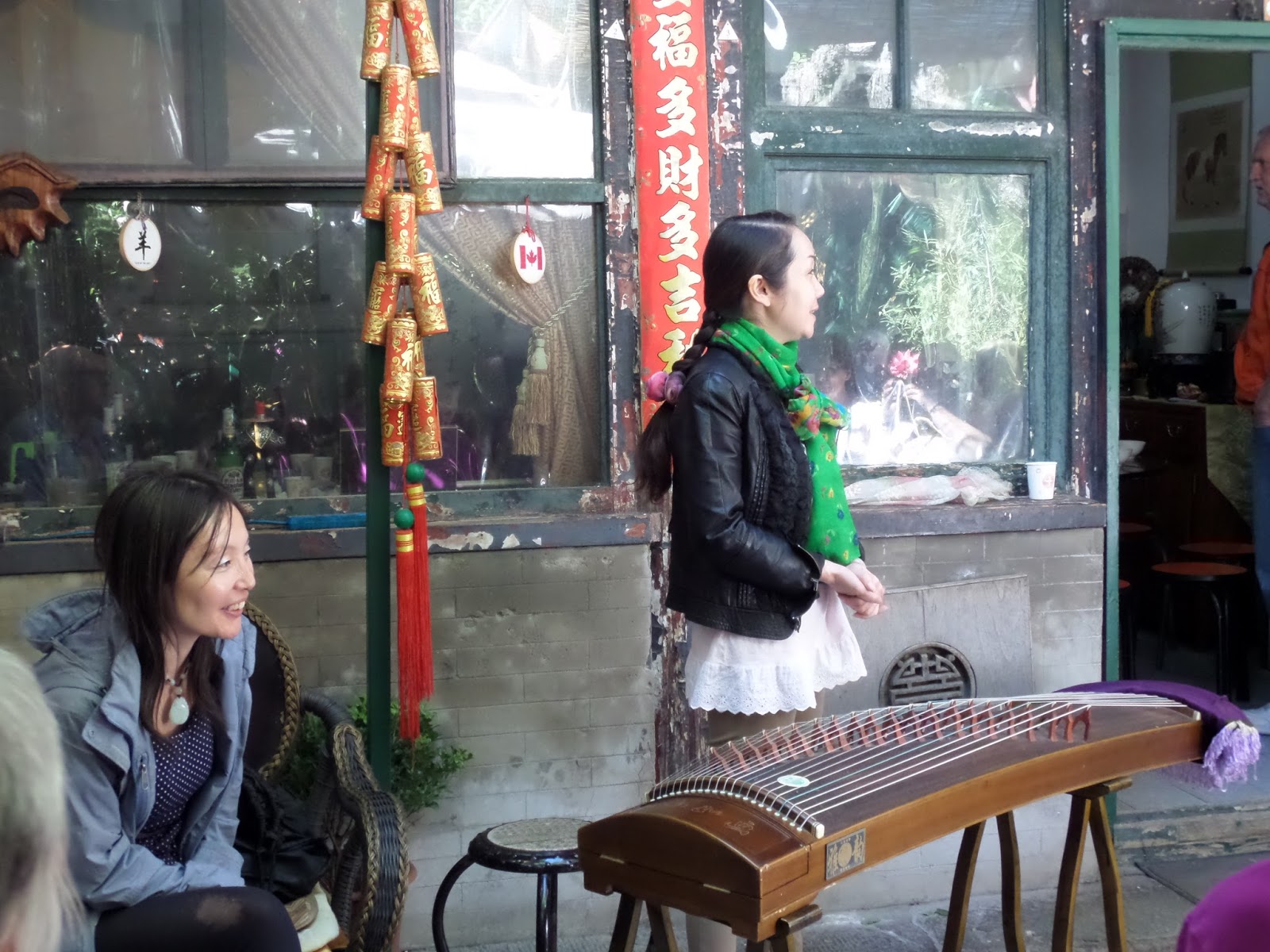
Traditional Chinese zither


However it was a very good lunch and our hostess played the zither in the courtyard. It was well worth the visit. 


After lunch we had a rickshaw ride through the Hutong lanes. The drivers earn their tips just by avoiding the traffic which although very slow moving is certainly heavy. 

Rickshaw driver waiting for a break in the traffic

Negotiating the traffic on the move

Even if lunch was not quite as authentic as advertised the leafy parochial Hutongs were fascinating to see and the contrast with ultra-modern high-rise Beijing was stark.

Wednesday, 4 November 2015

Day Three - The Olympic Park, some jade shopping and a Kung Fu show

In the afternoon we visited the Olympic Park where the 2008 games were held. Seeing the structures was fascinating even though it was still rather misty. You see these places in the media but don't think you'll ever actually see them yourself.
The National Stadium (The Bird's Nest)
The National Aquatic Center (Water Cube)
The Torch 
The Torch is now an enormous sculpture but during the games it was actually the Olympic torch and was fitted on top of the Bird's Nest stadium.

The stadium is very large and very clean (like everywhere we've seen in Beijing) and the extreme cleanliness is down to the efforts of all the orange-clad cleaners usually seen wielding witches-broom type besoms. The Olympic Park is such a large area they go about on motor scooters!  
A scooter-riding cleaner heads past the Bird's Nest
After lunch we headed to a jade gallery - gallery is quite a good term as it was certainly more than just a shop.  The statue pieces are full of impressive for their detailed carving. 
Check out the size compared to the man!
And compared to the fire extinguisher


Some are large - some are just massive! 
These end up in restaurant entrances.

Others are just beautifully made. Who wouldn't want this pair of bulls? Or the traditional Chinese dragon and Pixiu dragon?
Bulls
Pixiu is on the right


Pixiu - pronounced 'pea-shoe' is believed to be the youngest child of the dragon (male) and the phoenix (female). He has a dragon's head, a horse's body and a unicorn's feet. Most importantly he has no anus and is therefore a wealth-giver taking everything in and letting nothing out again! Apparently the pixiu is very popular with casinos (and gamblers) in Maccau who take the superstition seriously. 


Steady hand required
Other jade items include small pieces for the home like this 'family' ball being carved from a single piece of jade.

When complete it will consist of three or four  interlocked spheres. Larger ones can have up to nine spherical layers!

All the items are wonderfully carved but we had a sneaky feeling that out of their milieu the statues - especially the large ones - would appear a bit kitsch in suburban Europe. 


Huge jewellery saleroom

The jewellery however is a different matter. Jade jewellery is lovely and acceptable everywhere and they did have one or two nice pieces for sale! It took me a while but I managed to choose a wonderful birthday present. It would have been a shame to miss such an opportunity!

The character means 'longevity'
Neither lunch nor dinner provided a weird dish but as we were leaving the restaurant after dinner we passed the fish tanks full of the evening's menu offerings and saw something completely unidentifiable. Local guide Cathy said it was 'sea sausage' but Jason informed us that was known in the West as 'Chinese Penis Fish' - and not even he fancied eating that! I know you're thinking traveller's tales - but check it out on Wikipedia 

After dinner we went to the Red Theatre to see the Legends of Kung Fu show which proved to be much more entertaining than we might have guessed. 
No idea why it's called the Red Theatre!
Kung Fu show


Not only was there Kung Fu but also stick fighting and sword fighting and acrobats. There was even a ballerina! All very theatrical.


It's fast-moving

Theatrical

Altogether a pretty good show
We finished the evening with a glass of French red wine in the hotel bar. It cost a similar price to a glass of wine at home and the quality was actually very good. You can get Chinese wine, but apparently most of it is not of a very high standard. Chinese people are newcomers to wine made from grapes and although it's gaining in popularity among the newly wealthy their viticulture is in it's infancy. Anyway this French wine made a nice change from beer.